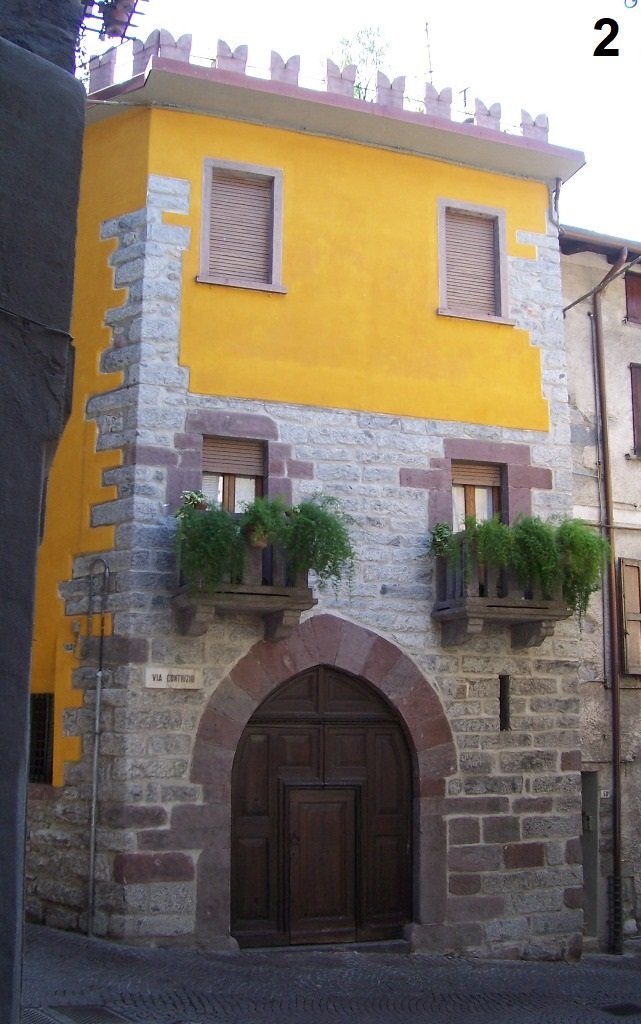
Bienno, also known as the “Village of the Seven Towers,” still preserves four of the defensive structures typical of the late medieval period in nearly perfect condition.
These structures served primarily defensive purposes; the square-shaped walls were very thick, which reduced the living spaces and the number of windows facing the village.
These windows, in addition to providing a view of the village, served as entrances, thanks to ladders lowered from the window closest to the street.
This prevented potential external attacks, as there were no entrance gates that could be broken down; in dangerous situations, the tower’s inhabitants simply had to pull up the access ladders.
Continuing up the hill, at the intersection of Via Castello and Piazza Roma, Torre Rizzieri stands out...
On the northeast side, facing Via Contrizio, the pointed-arch entrance portal made of Simona stone is prominently displayed; next to the entrance, a slit had been carved out to monitor comings and goings.
Above the portal, in the 1950s, two small balconies were added on both the right and left sides; the upper part of the tower underwent extensive restoration, and two windows were added on the second floor. Above them, a series of swallowtail battlements can be seen, which were also added in the 1950s.
The southwest facade overlooks Piazza Roma and features an addition, likely built in the 18th century, characterized by an exterior staircase. At the corner of the square, two carved granite blocks can be seen; one is now indecipherable, but the second depicts a small head in the Romanesque style.
(The proposed itinerary is an excerpt from the research conducted by architects Giorgio Azzoni and Virtus Zallot and from the fourth volume of *Arte in Valcamonica* by Araldo Bertolini and Gaetano Panazza)