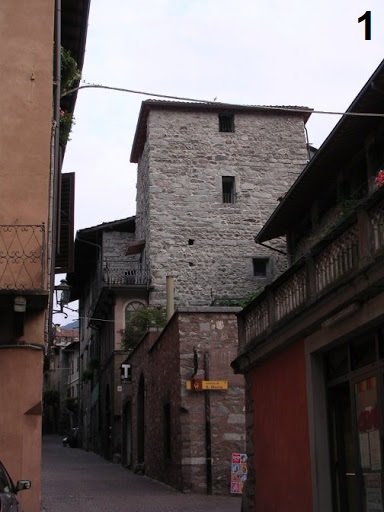
Bienno, also known as the “Village of the Seven Towers,” still preserves four of the defensive structures typical of the late medieval period in nearly perfect condition.
These structures served primarily defensive purposes; the square-shaped walls were very thick, which reduced the living spaces and the number of windows facing the village.
These windows, in addition to providing a view of the village, served as entrances, thanks to ladders lowered from the window closest to the street.
This prevented potential external attacks, as there were no entrance gates that could be broken down; in dangerous situations, the tower’s inhabitants simply had to pull up the access ladders.
Starting from Via Contrizio, the street leading to the historic center, the first structure you catch a glimpse of is Torre Avanzini, the most imposing of them all, standing 17 meters tall, with a perimeter of 830 x 780 cm and walls 135 cm thick.
One immediately notices that the tower is surrounded by a square-based walled enclosure and that there are no direct access doors, only windows; the one closest to the street—and the smallest—served as the entrance, as mentioned earlier.
Rumors have it that, during some excavations, human remains—now reduced to bones by the passage of time—were found at the rear of the tower, in a crevice a few meters wide bordering a nearby building.
(The proposed itinerary is an excerpt from the research conducted by architects Giorgio Azzoni and Virtus Zallot and from the fourth volume of *Arte in Valcamonica* by Araldo Bertolini and Gaetano Panazza)