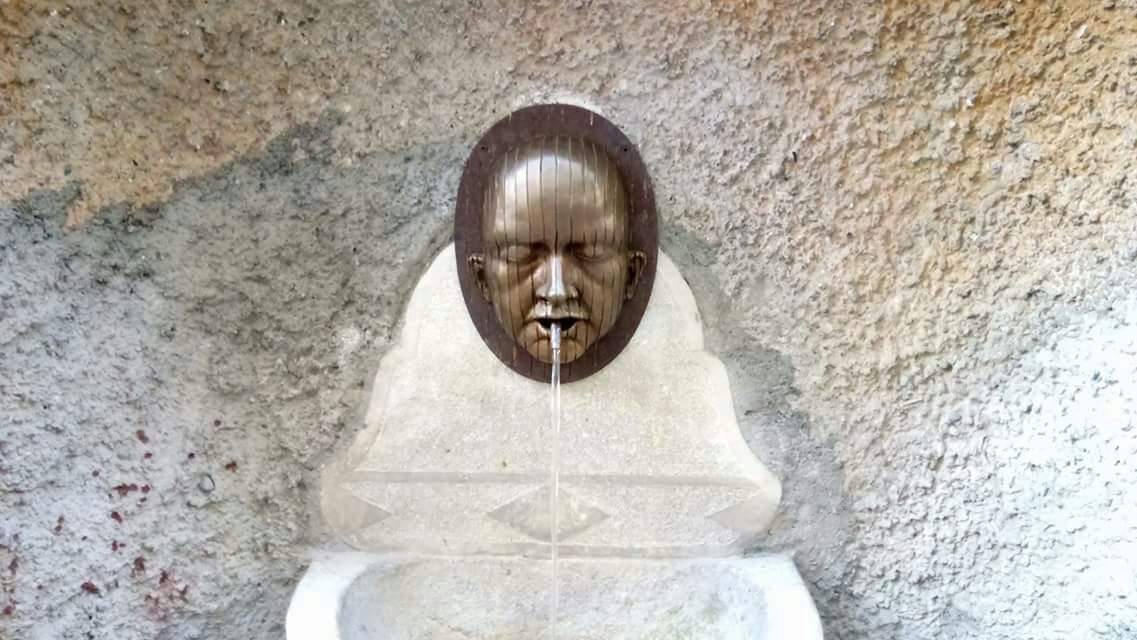
We move away from the Vaso Rè, yet we continue to hear the soundtrack of flowing water from the many public fountains that characterize this village—so much so that it has earned the nickname "Biénn Fontanéar" (Bienno of the Fountains).
Let us examine the most common type of fountain—the semi-chalice—in its various configurations: Wall-mounted semi-chalice with backplate ("SAF") Semi-chalice with backplate ("SF") Wall-mounted semi-chalice ("SA") The Via Contrizio fountain (7) is one of a series of five small fountains dating back to the mid-19th century.
Made of Botticino marble, they feature a semicircular base and a shaped shaft that supports a rounded basin with a curved rim. A water spout and a scroll-shaped hook for holding a bucket project from the curved backplate.
Fountains of the "SAF" and "SA" types can be found on Via Re (2), Via Castello (4), Via di Mezzo (5), and Via Contrizio (7).
Each one is distinguished by whether its base rests directly on the ground or on a pedestal—specifically, a stone step. Where present, the backplate rests against a stone wall or is set within a niche (as seen on Via Contrizio);
the only exception is the fountain on Via Resoleto (3), which lacks a backplate.
A modern reinterpretation of this style can be found on Via Santa Maria (6), Via Ripa, Via Glere, and Via Prati (1).
(The proposed itinerary is an excerpt from the book *Alla scoperta del Vaso Rè lungo il racconto disegnato dall'acqua* by Ivana Passamani Bonomi and Lucia Morandini Ruggeri)